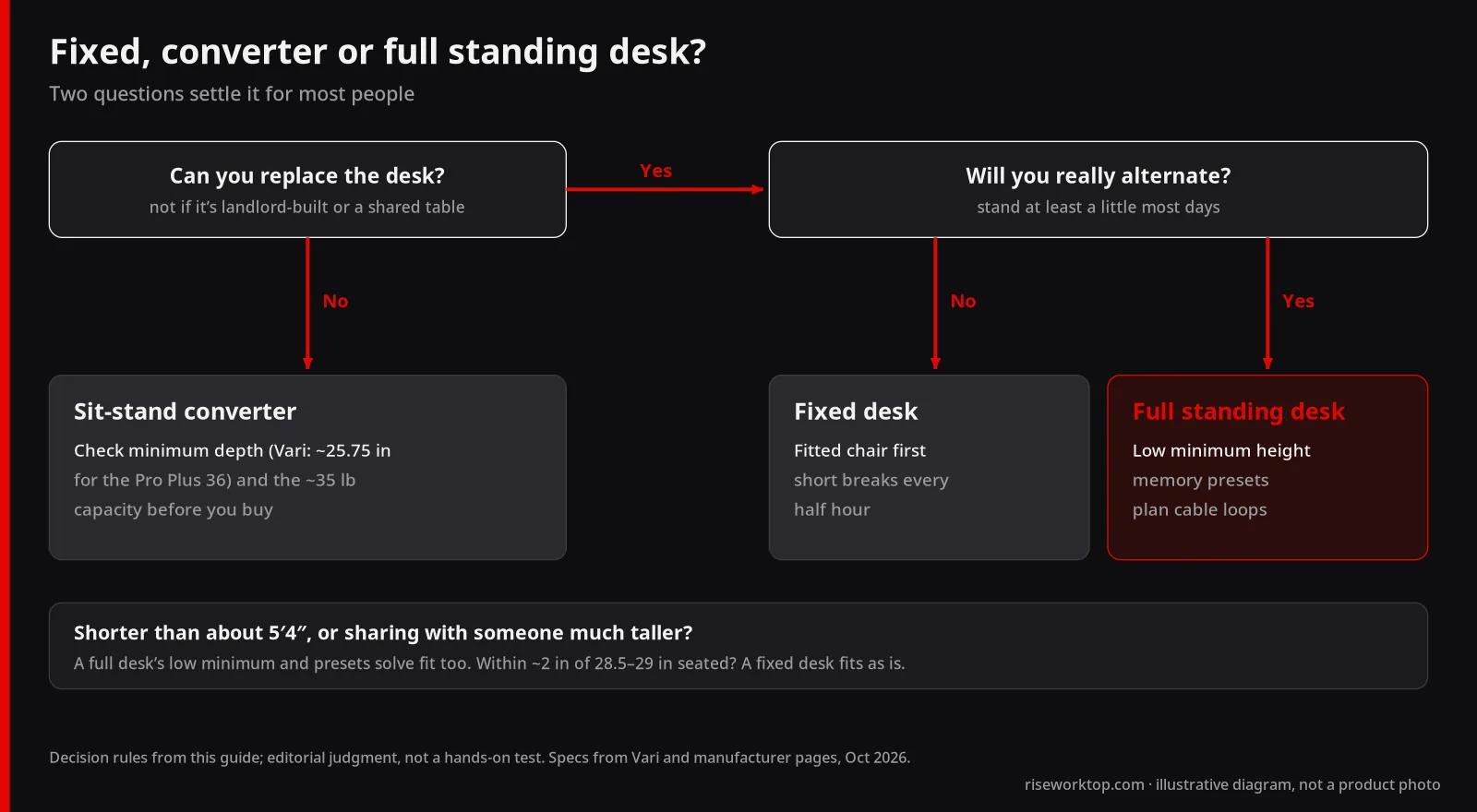
My short answer: most people who mostly sit should keep a fixed desk and spend on a better chair. If you can't replace your desk, a sit-stand converter is the stopgap. If you'll really alternate postures, or you're short, or two people share the desk, a full standing desk earns its price. I'd skip the converter if you're already replacing the desk. The reasons are below, and they come from spec sheets and prices, not brand hype.
Research note: AI-assisted research and writing, not hands-on tested. Written by Rhett Varley. No desks or converters were measured or tested for this page, so every opinion here is a judgment from published specs, prices and research. Sitting-time figures come from a 2018 Cochrane systematic review, workstation guidance from OSHA, body-size rows from the ANSUR II summary in our desk size chart, and product specs and prices from manufacturer pages checked in October 2026 (how we research).
Quick answer
- Fixed desk: pick this if you mostly sit, your seated desk-surface target is within about 2 inches of the 28.5–29 in most fixed desks are built at (or you can raise your chair and add a footrest), and you'd rather spend on a better chair.
- Converter: pick this only if you must keep a desk you can't replace (rental, built-in, shared table), or you want a cheap test of standing. The desk has to be deep enough, and the load has to fit the converter's published capacity.
- Full standing desk: pick this if you'll alternate postures most workdays, two people of different heights share the desk, or you're under about 5′6″ and want the desktop itself to come down to your seated height.
Approximate US ranges as of October 2026: converters about $150–$450, complete standing desks about $250–$700+. Within one brand, the step up from fixed costs real money. Branch lists its fixed Daily Desk from $299 and its Duo standing desk from $549.
Browse the standing desks topic hub for related guides.
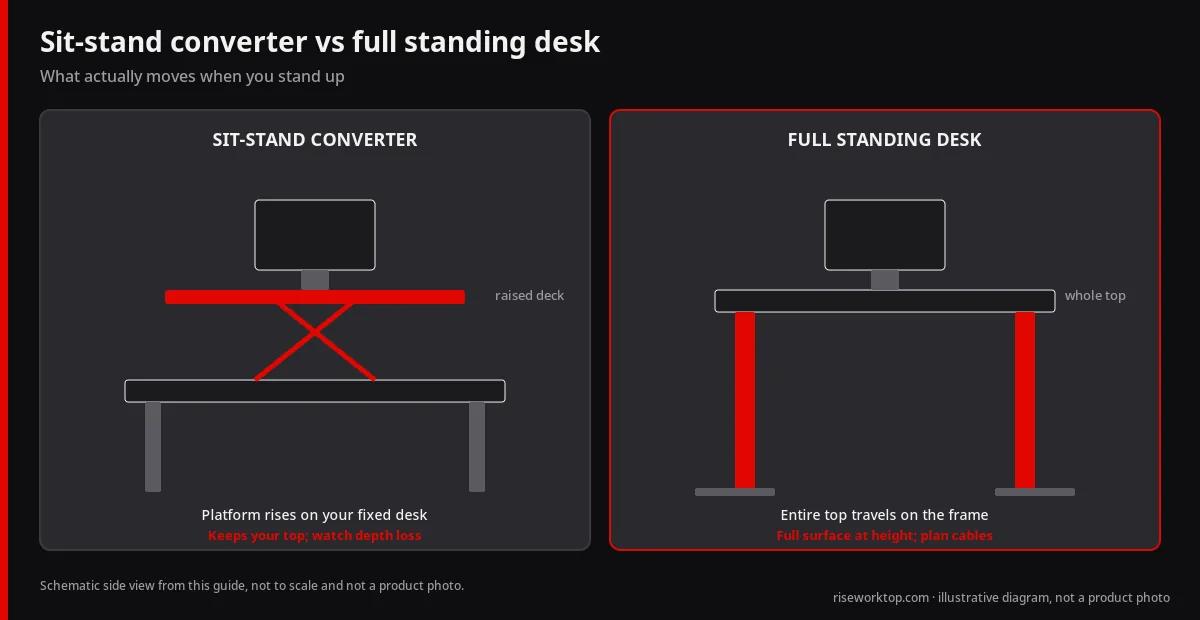 Converter on a fixed desk (left) vs full standing desk (right). — RiseWorktop diagram (original)
Run your height numbers before you pick a type
A height mismatch is the most common reason a desk fails, and no amount of feature-shopping fixes it. So start here. The rows below come from the desk height calculator. It interpolates four published ANSUR II stature rows and uses a 1.00 in shoe allowance (standing only) and a 1.00 in keyboard thickness. These are planning estimates from published reference values, not measurements.
| Published row (stature) |
Sitting desk surface |
Standing desk surface |
Frame travel to cover both |
Gap to a 28.5 in fixed desk |
| 5th percentile women (60.04 in) |
20.22 in |
36.69 in |
16.47 in |
28.5 − 20.22 = 8.3 in too high |
| 50th percentile women (64.02 in) |
23.41 in |
39.45 in |
16.04 in |
28.5 − 23.41 = 5.1 in too high |
| 50th percentile men (69.09 in) |
25.62 in |
42.64 in |
17.02 in |
28.5 − 25.62 = 2.9 in too high |
| 95th percentile men (73.62 in) |
29.00 in |
45.94 in |
16.94 in |
Within 0.5 in |
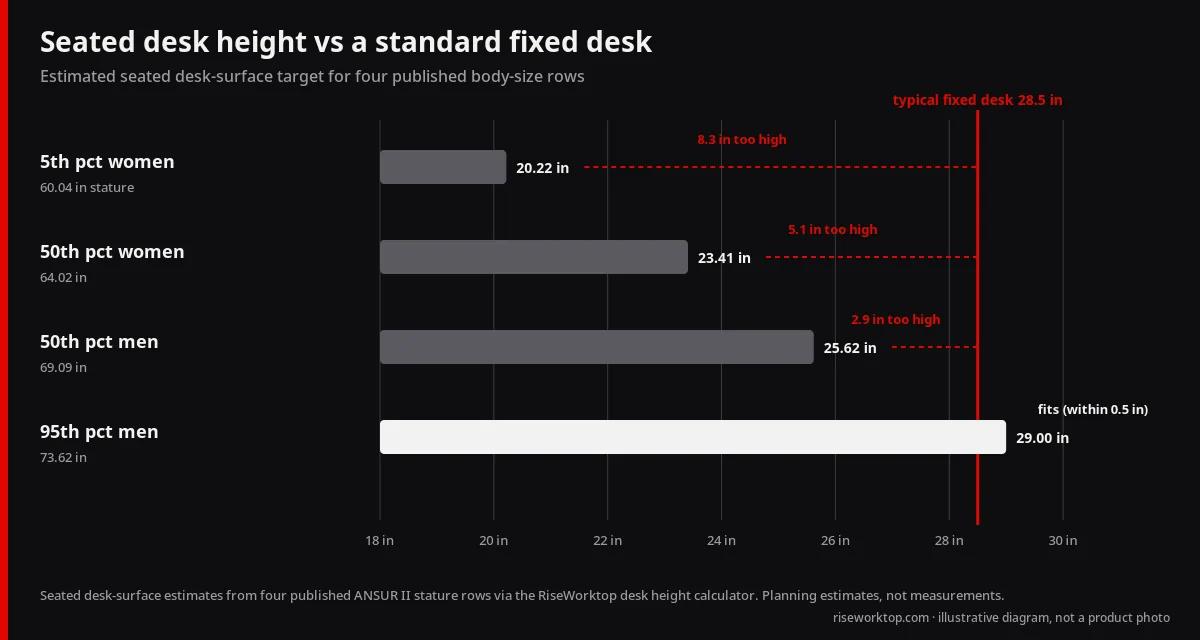
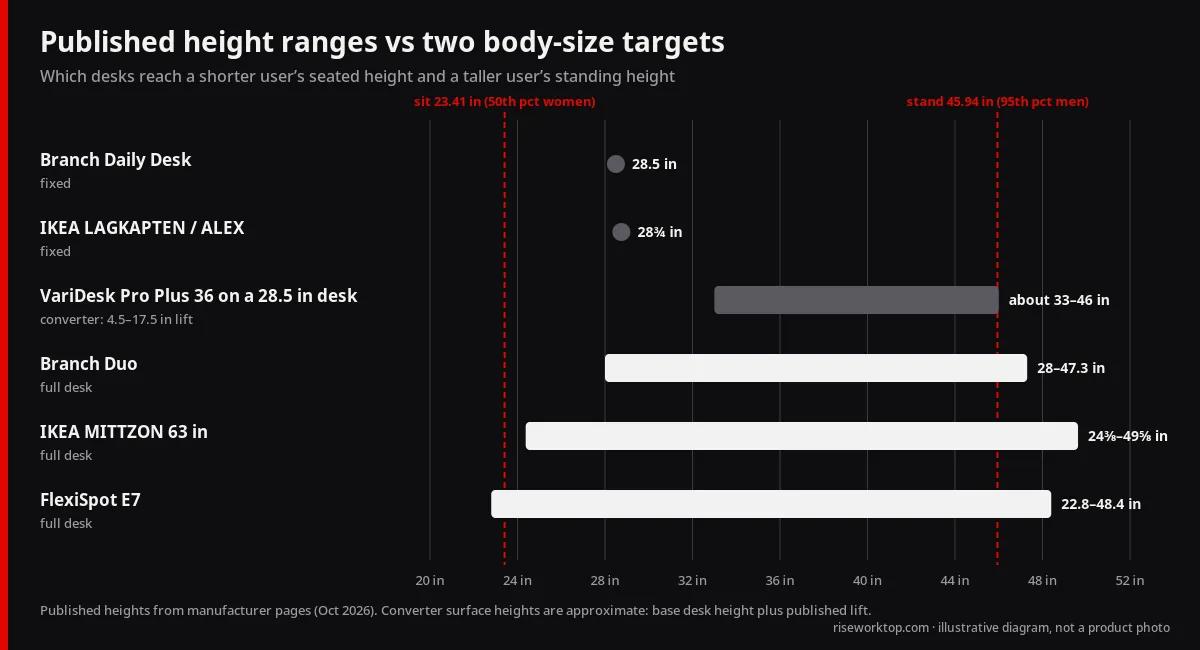
Look at that last column. Only the tallest row fits a standard fixed desk as it comes. Everyone else is about 3 to 8 inches too high.
- If you're on a fixed desk: OSHA's fixes (further down) can close a 3–5 inch gap. For the shortest row I'd stop patching and look at a sit-stand frame with a low minimum.
- If you're eyeing a converter: it fixes the standing number but can't lower your seated height. Check its lift range (4.5–17.5 in on the VariDesk Pro Plus 36) against the gap to your standing surface.
- If you're eyeing a full desk: compare its published minimum and maximum with both columns. For the 64.02 in row, the IKEA MITTZON's 24⅜ in minimum is about 1 inch above the 23.41 in estimate. The Branch Duo's 28 in minimum is about 4.6 inches above it. The FlexiSpot E7's 22.8 in clears it. All three maximums cover the 45.94 in standing surface of the tallest row.
That second point is worth pausing on. The Branch Duo's 28 in minimum is about the same as a fixed desk's height. For a shorter user it adds standing and does nothing for the seated gap.
What the research does and doesn't say
The most-cited summary is a 2018 Cochrane review of workplace interventions for reducing sitting (Shrestha et al.). In plain terms:
- Sit-stand desks reduced workplace sitting by about 100 minutes per day at up to 3 months of follow-up (range 84–116 minutes; 10 studies, low-quality evidence).
- At 3–12 months the reduction was smaller, about 57 minutes per day (2 studies).
- The authors rate the evidence low to very low quality, expect the effect to shrink over time, and found no evidence beyond one year.
- In one study, short breaks of 1–2 minutes every half hour cut sitting at work by about 40 minutes per day compared with two long breaks (low-quality evidence).
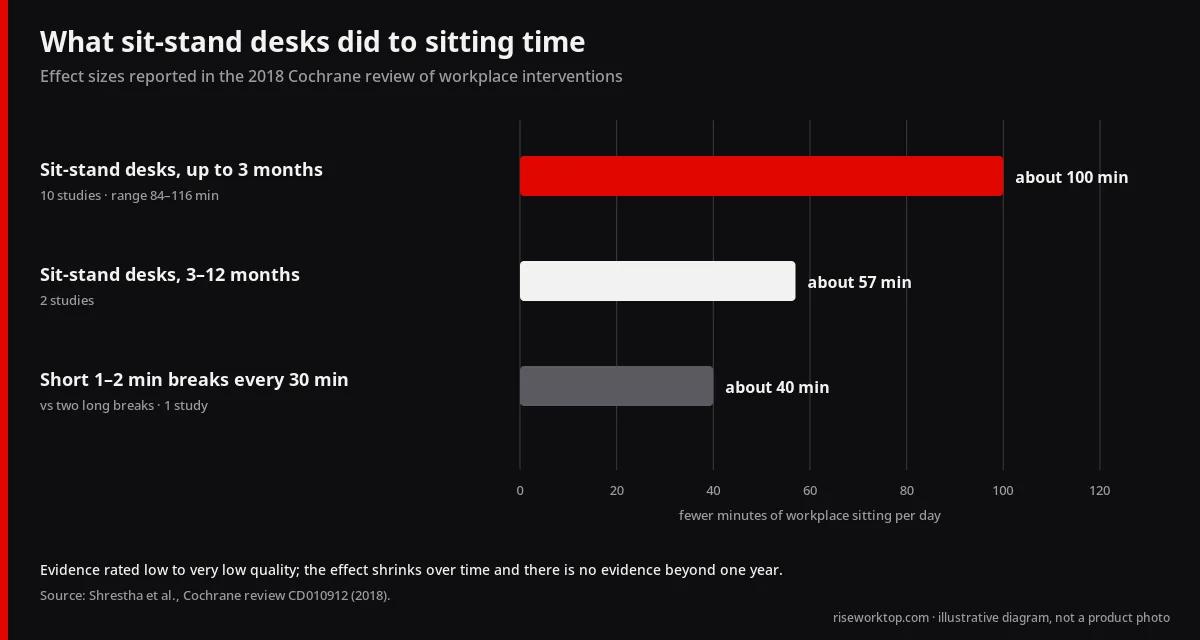
So a standing desk does change how long you sit, at least at first. The review doesn't show that owning one fixes back pain or improves health outcomes by itself. And note that last bullet. A fixed-desk user who takes frequent short breaks gets part of the same change for free. I'd keep that in mind before paying for a motor.
Fixed desk: when I'd stop here
A fixed desk isn't a compromise by default. It's the simpler tool, and simple counts for a lot at a desk you use eight hours a day. Here's when I'd leave it alone.
- You mostly sit. If you'd stand for a few minutes and then sit down again, the extra cost buys little. Short, frequent breaks give you movement without hardware.
- Your seated height is close to the desk. The calculator figures above put the seated target near 29 in for a ~6′2″ user, so a 28.5–29 in fixed desk suits taller sitters almost exactly. It's within reach for average sitters once the chair is raised.
- The chair is the weaker link. See what a good chair should offer in ergonomic office chair under $400.
- You want it steady. Four fixed legs have nothing to wobble. That matters for dual monitors on arms, heavy typing and video calls.
- You rent or may move. There are no motors or controller, and lighter models are easier to carry, sell or leave behind than an electric frame.
Here's my bias, so you can discount it. For many beginners I'd put money into the chair and a stable desk first and add sit-stand later. That's an editorial preference, not a universal rule, and it isn't proof that standing desks are a bad buy. If you already know you feel better alternating postures, a converter or full desk is reasonable.
Making a fixed desk fit
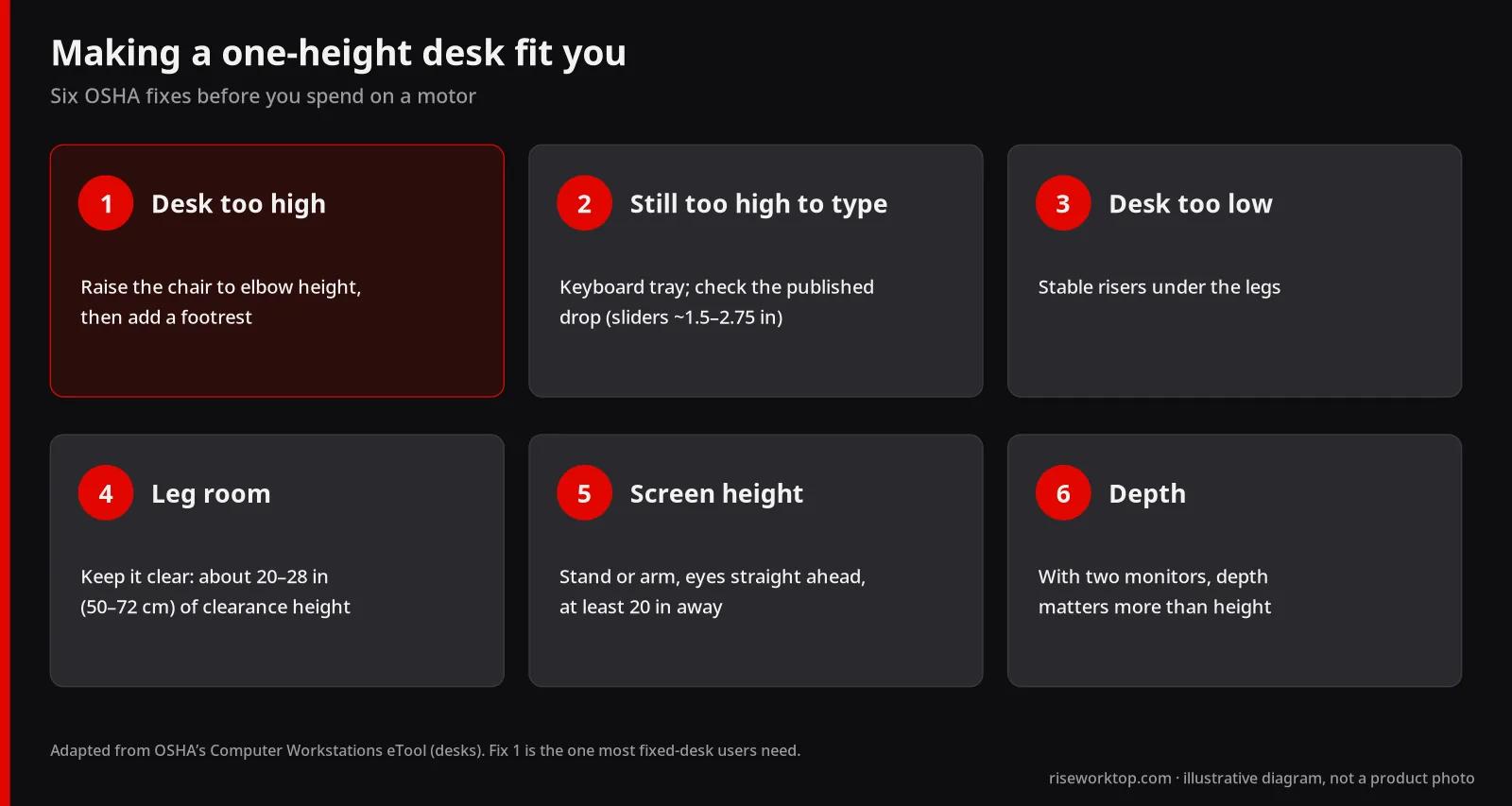
OSHA's desk guidance covers the usual problems with a one-height desk:
- Desk too high (the most common): raise the chair until your elbows sit at about desk height, then add a footrest so your feet stay supported. Our guide to footrests and anti-fatigue mats covers sizing.
- Still too high for typing: add a keyboard tray so the keyboard sits below the desktop. Check the published drop first; basic clamp-on sliders only drop about 1.5–2.75 in.
- Desk too low: OSHA suggests stable risers under the legs.
- Leg room: keep the space under the desk clear. OSHA says leg clearance should generally be 20–28 inches (50–72 cm) high. Skip center drawers that cut into thigh space.
- Screen height: set the monitor with a stand or arm so you look straight ahead, at least 20 inches away, rather than changing the desk.
- Depth: for two monitors, depth matters more than height. See 24 vs 30 inch desk depth and the desk size chart.
Converters: a stopgap, not an upgrade
I think of a converter as the answer to one question: "I can't replace this desk, can I still stand at it?" For that, it's reasonable. As a first choice when you're free to buy any desk, I don't love it, for three reasons I can see on the spec pages.
| Your situation |
Lean toward |
| Landlord-built desk you can't replace |
Converter |
| Shared family table after hours |
Converter (remove or lower when done) |
| Testing whether standing helps before a big buy |
Converter |
| Dedicated office, dual monitors, dock, tidy look |
Full standing desk |
| Maximum stability for heavy arms / ultrawide |
Full standing desk |
| Two people of very different heights |
Full standing desk (memory presets) |
Capacity is thin. Both converters below list about 35 lb. Dual monitors, arms and a desktop PC can use that budget up quickly, so check the number before you fall for the look.
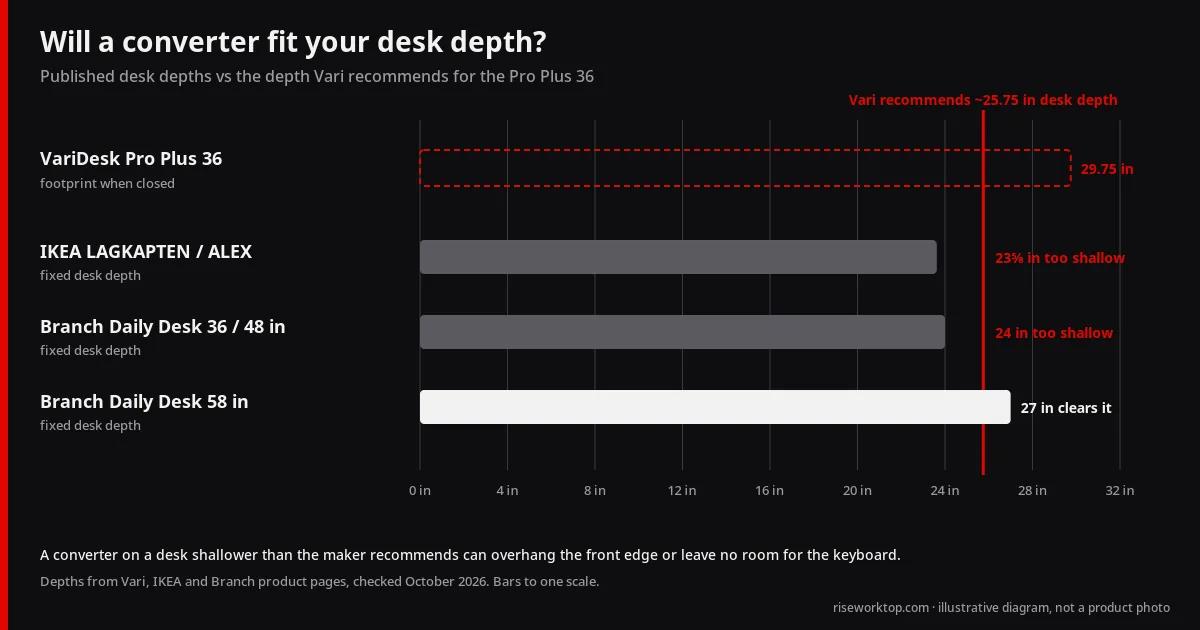
Depth is a hidden cost. Many converters want a mid-20-inch-class desk, so check the spec sheet. Vari recommends about 25.75 in for the Pro Plus 36 and lists it at about 29.75 in deep when closed. Compare that with the fixed desks in this guide: the IKEA LAGKAPTEN / ALEX is 23⅝ in deep, and the Branch Daily Desk is 24 in deep in its 36 and 48 in widths. Only the 58 × 27 in Branch size clears 25.75. A converter on a shallow desk can leave you with a platform that overhangs, or no room left for the keyboard.
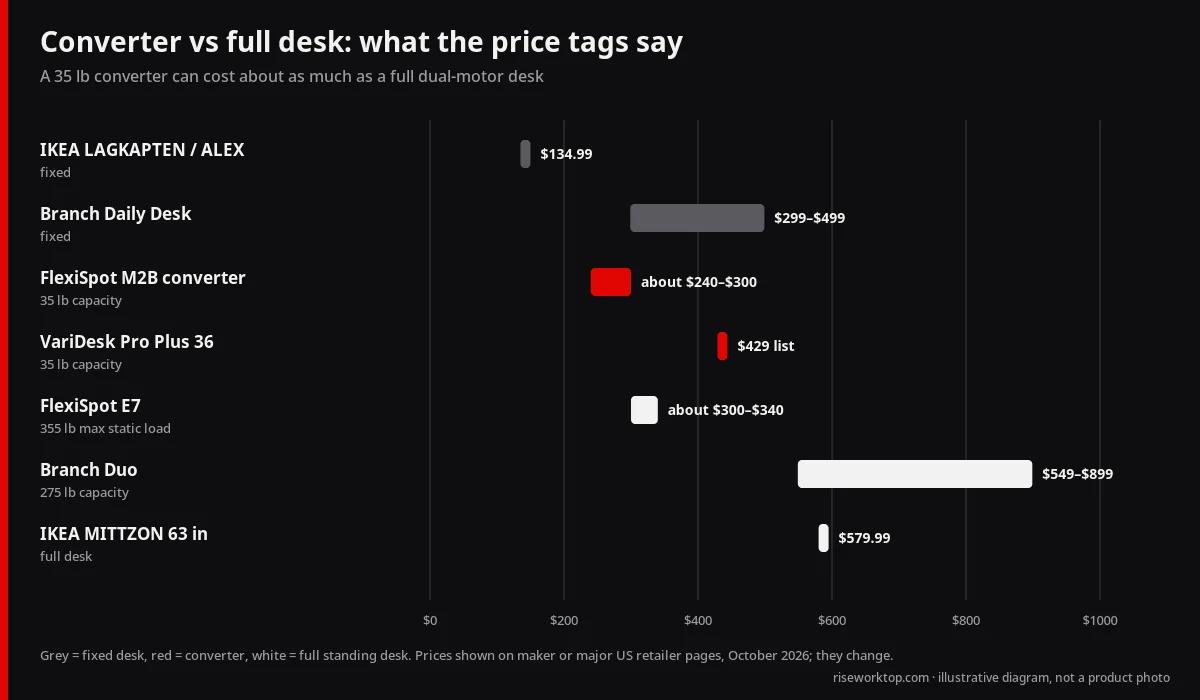
The price doesn't always make sense. Vari lists the Pro Plus 36 at $429, and the FlexiSpot E7 is listed around $300–$340 for common bundles. On paper, a full dual-motor desk with a 355 lb static rating costs less than a 35 lb converter. Those aren't identical products, and the E7 price depends on the bundle you pick. Even so, if you're about to replace the desk anyway, I'd spend the money on the desk. And the M2B at about $240–$300 lists the same 35 lb capacity as the Vari, so I'd want a clear reason before paying roughly $130–$190 more for the Vari.
Two practical notes. Cables travel with the lift on a converter, while a full desk needs a surge strip under the top and a service loop (cable management for standing desks). And don't stack a converter on a standing desk. Pick one height-adjustment system.
Full standing desks: when the money makes sense
I'd pay for one when at least one of these is true:
- You'll really alternate. A sit-stand desk only changes your day if you use it. If you already stand to read, take calls or think, it fits a habit you have.
- You're shorter than average. For a ~5′4″ user the seated surface target is about 23–24.5 in, roughly 4–5 inches below a typical fixed desk. A frame with a low minimum lets the desktop meet you.
- Two people share the desk. A 5′2″ and a 6′2″ user can't both fit one fixed height. Memory presets settle it in seconds.
- You want the whole surface. Full desks publish frame capacities that usually include the top.
For small rooms, see how to choose a standing desk, including compact-apartment picks.
Fixed vs converter vs standing desk at a glance
| Factor |
Fixed desk |
Sit-stand converter |
Full standing desk |
| Approx. cost (Oct 2026) |
About $135–$500 for the fixed models below |
About $150–$450 for many solid units |
About $250–$700+ for many complete kits; $549–$900 for the Branch and IKEA models below |
| Height |
One height, about 28.5–29 in (Branch Daily Desk 28.5 in; IKEA LAGKAPTEN/ALEX 28¾ in) |
Adds lift on top of your desk: 4.5–17.5 in on the VariDesk Pro Plus 36 |
Published range, e.g. 28–47.3 in (Branch Duo) or 24⅜–49⅝ in (IKEA MITTZON 63″) |
| Fit for shorter sitters |
Usually too high; fix with a raised chair plus footrest or a keyboard tray |
Sits on top of the desk, so it cannot lower your seated height |
Can come down to a lower seated height if the minimum is low enough |
| Stability |
No telescoping legs, so usually steadiest at full load |
Good units are fine; cheap ones rock with dual monitors |
Usually better if the frame is rigid; more sway near the top of the range |
| Cables and moving parts |
None |
Devices move on the upper tier; base desk stays put |
Entire surface travels, so plan service loops; motors, controller, and cord |
| Surface you can use while standing |
The desk itself, at one height |
Mostly the converter's upper/keyboard tiers |
The whole desktop |
| Effect on sitting time |
None by itself; breaks are up to you |
Makes standing possible without a new desk |
Cochrane review: about 100 fewer minutes of workplace sitting per day in the first 3 months (low-quality evidence) |
| Best when… |
Mostly-seated work, chair-first budgets, rentals, simple setups |
You must keep a shared or built-in desk |
You control the room and want a clean long-term setup |
| Weak when… |
You are much shorter than average, or share with someone much taller |
Desk too shallow (often ~25 in+ needed), load near capacity, heavy ultrawide |
Budget is tight and a solid fixed desk already fits |
Models worth checking (as of Oct 2026)
These aren't rankings and they aren't hands-on tests. Heights, capacities and prices are copied from each manufacturer's own product page in October 2026. Prices and configurations change.
| Model |
Type |
Published height |
Price shown (Oct 2026) |
Notes from the spec page |
| IKEA LAGKAPTEN / ALEX (55⅛×23⅝″, black-brown/black) |
Fixed |
28¾ in |
$134.99 |
Tabletop on one ALEX storage unit and two legs |
| Branch Daily Desk |
Fixed |
28.5 in |
$299–$499 by size |
36, 48, or 58 in wide; BIFMA; 10-year warranty |
| VariDesk Pro Plus 36 |
Converter |
4.5–17.5 in lift |
$429 (Vari US list; promotions sometimes lower) |
35 lb capacity; 11 height settings |
| FlexiSpot ClassicRiser M2B (35″) |
Converter |
Gas-assisted lift |
about $240–$300 across major US retailers (FlexiSpot's own page showed no stable price) |
About 35 lb on the desktop |
| Branch Duo Standing Desk |
Full desk |
28–47.3 in |
From $549 (up to $899 by configuration) |
275 lb capacity |
| IKEA MITTZON sit/stand electric (63×23⅝″) |
Full desk |
24⅜–49⅝ in |
$579.99 |
Wider top than the LAGKAPTEN above |
| FlexiSpot E7 |
Full desk |
22.8–48.4 in |
about $300–$340 |
355 lb max static load |
Fixed desks
IKEA LAGKAPTEN / ALEX
- Key specs (per IKEA): 55⅛″ wide, 23⅝″ deep, 28¾″ high; the black-brown/black set pairs the tabletop with one ALEX storage unit and two legs, listed at $134.99.
- Spec source: IKEA LAGKAPTEN / ALEX product page.
- Not a good fit if… you need more than 23⅝ inches of depth for two monitors, or you want drawers on both sides.
- My take: at $134.99 it's the cheapest way to get a stable sitting desk in this guide. If your seated height is close to 28¾ in, I'd start here and put the savings into a chair.
Branch Daily Desk
- Key specs (per Branch): fixed 28.5″ height; 36×24″, 48×24″, or 58×27″; powder-coated steel and laminated MDF; meets BIFMA; 10-year warranty; $299–$499 by size.
- Spec source: Branch Daily Desk.
- Not a good fit if… you're shorter than average and don't want a raised chair and footrest.
- My take: the warranty is the good part. The price is the hard part, since it costs more than twice the IKEA set at the low end of its range. I'd only pay it if you want the Branch size options or its 10-year coverage.
Converters
VariDesk Pro Plus 36
- Key specs (per Vari): width 36″; overall about 4.5″ H × 36″ W × 29.75″ D when closed; 11 height settings from 4.5″ to 17.5″; weight capacity 35 lb; product weight ~52 lb; recommends ~25.75″ desk depth; two-tier keyboard deck; delivered fully assembled; lifetime warranty language on page; GreenGuard Gold / BIFMA testing called out.
- Spec source: VariDesk Pro Plus 36.
- Not a good fit if… your monitors + laptop already exceed 35 lb, your desk is shallower than Vari's recommended depth, or you want electric one-touch lift (Vari sells separate electric converter SKUs).
- My take: the 11 height settings and the lifetime warranty wording are the selling points. I'd read the actual warranty terms before counting "lifetime" as value, since they aren't summarized here.
FlexiSpot ClassicRiser M2B (35″)
- Key specs (per FlexiSpot): 35″ class converter; max about 35 lb on the desktop; gas-assisted lift (~13 lb of force to raise, ~3 lb to lower per FlexiSpot); removable keyboard tray; designed to sit on an existing desk (FlexiSpot notes height fit examples for ~28″ and ~31″ base desks).
- Spec source: FlexiSpot ClassicRiser M2B.
- Not a good fit if… you need a wider dual-monitor upper surface than the M2B platform, or you prefer a weighted non-clamp converter with published 11-step height detents like Vari's Pro Plus.
- My take: on paper it's the better value of the two converters, with the same 35 lb and a lower price. Its own page showed no stable price, so shop around.
Full standing desks
Full specs for the three desks in the table (dual-motor frames, capacities, memory presets, noise, warranty) are in how to choose a standing desk. Here's what matters for the three-way decision.
- Branch Duo (spec source): 28″–47.3″ height range, 275 lb capacity, from $549 (up to $899 by configuration). Not a good fit if… you need a seated height below 28″. Its minimum is about the same as a fixed desk, so it adds standing, not a lower sit. I'd skip it for short users.
- IKEA MITTZON 63×23⅝″ (spec source): min height 24⅜″, max 49⅝″; $579.99 for the white version. Not a good fit if… you want the lowest possible price. A fixed desk plus a better chair costs less.
- FlexiSpot E7 (spec source): dual-motor, 22.8″–48.4″, 355 lb max static load; about $300–$340 for common bundles; it replaces the whole desk instead of stacking a converter. Not a good fit if… you can't replace built-in furniture, or you only need occasional standing on a shared fixed desk (a converter may fit that better). On paper it's the strongest value here. I'd check the warranty and the lifting capacity behind that "static load" wording first.
Prices checked Oct 2026; they change. For more sit-stand options by price, see standing desks under $500.
Decision checklist
- Measure your seated elbow height with your feet flat, or run the calculator. Within about 2 inches of 28.5–29 in, a fixed desk fits as is. Otherwise a raised chair plus footrest or a keyboard tray is the cheap fix, and a sit-stand frame with a low minimum is the expensive one.
- Be honest about standing. If you wouldn't stand at least a little most days, start fixed.
- Check depth and capacity on a converter's spec sheet before you buy.
- Price the full setup (desk, chair, monitor and arm) with the home office budget planner before you spend the difference on a motor. The home office setup checklist has a sensible buying order.
- If you're unsure, start fixed and add a converter later. You can upgrade without throwing the desk away.
FAQ
Is a sit-stand converter as good as a standing desk?
For many people it's "good enough," especially if you must keep an existing desk. A full standing desk usually wins on stability, whole-surface usability and long-term cable simplicity. If you're free to choose, I'd lean toward the desk.
How much desk depth does a converter need?
Check the manufacturer's minimum depth. Many dual-monitor converters want roughly mid-20-inch depth or more (Vari recommends about 25.75 in for the Pro Plus 36). A shallow desk may force a narrower converter, or a full desk instead.
Can I use a converter on a standing desk?
I'd say no. Stacking adds instability and cable mess, and you only need one height-adjustment system.
Is a fixed sitting desk a bad choice, or bad for your health?
No. A stable fixed desk with a fitted chair is a solid setup. The Cochrane review found standing desks mainly reduce sitting time, and the evidence is low quality. A fixed desk that fits you, a supportive chair and short breaks every half hour are a reasonable setup for most home-office workers. Preferring that path for beginners who need to spend on the chair first is an editorial preference, not a rule.
How much less do people sit with a standing desk?
In the 2018 Cochrane review, sit-stand desks cut workplace sitting by about 100 minutes per day in the first three months and about 57 minutes per day at 3–12 months. The evidence was low quality, and there were no data beyond one year.
What height is a standard fixed desk, and is it too tall for short people?
Most fixed desks are built around 28.5–29 inches. Branch's Daily Desk is 28.5 inches and IKEA's LAGKAPTEN / ALEX is 28¾ inches, per their product pages. For shorter users that's often too high. A ~5′4″ user's seated desk-surface target is about 23–24.5 inches, so the desk is 4–5 inches high. Raise the chair and add a footrest, use a keyboard tray, or choose a sit-stand frame with a low minimum height. A converter won't help the seated height.
How much more does a standing desk cost than a fixed desk?
From the same brand, Branch lists the fixed Daily Desk from $299 and the Duo standing desk from $549, about $250 more. Across brands, the models in this guide run about $135–$500 fixed and $549–$900 for the Branch and IKEA sit-stand desks, as of October 2026. Converters run about $150–$450.
Which option is better for dual monitors?
Both can work, but I'd lean toward a full desk with enough depth and a proper monitor arm setup. On a converter you have to confirm the capacity and the width of the upper tier. Depth guidance: 24 vs 30 inches.
Should I buy a standing desk or a better chair first?
If you mostly sit and the budget covers only one upgrade, I'd buy the chair, because it touches more of your day. Start with a stable fixed desk and a well-fitted chair, then add a converter or full standing desk later if you find you want to stand.
What is the cheaper way to try standing?
Usually a mid-tier converter on a desk you already own, provided depth and capacity fit. If you were already going to replace a weak desk, put that money toward a full standing desk rather than stacking costs.
Sources
Where I'd put the money
Start with the chair and a fixed desk that already fits you. Add a converter only when the desk can't be replaced. Buy a full standing desk when your own numbers, or a second user, say a fixed height will never work. Run those numbers in the desk height calculator before anything else.
